


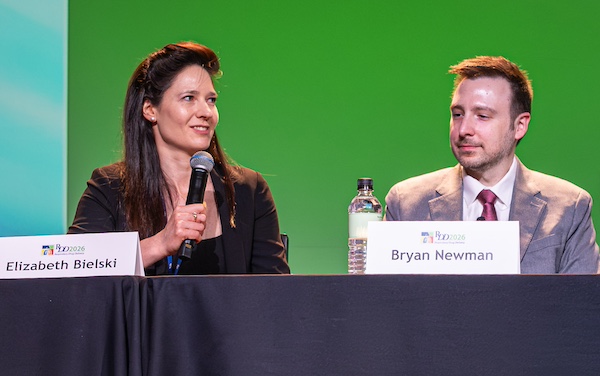
Newman reported on FDA-sponsored research comparing LGWP MDI formulations with current formulations, with data showing differences in spray characteristics, stability, delivered dose, and deposition but no change in particle morphology or dissolution attributed to a change in propellant. He pointed out that what Bielski said regarding the use of rAPSD and reduced spray testing for determining BE in generic MDI development also applies to determination of BE for new LGWP formulations and that developers should focus on matching the same four in vitro tests that she mentioned, plus in vivo PK.
In addition to reviewing the FDA’s work on guidance for the current LGWP transition, Luke explained that the agency is also trying to ensure that it will be prepared for any potential future propellant transitions. He noted that FDA is hiring and has job openings for postdoctoral fellowship positions in this field.
Four of the eleven workshops offered during the workshop session addressed the LGWP transition: Bespak‘s “Towards the Ultimate High Performance, Low Carbon pMDI: The Role of Valves in the Net Zero Journey”; Orbia‘s “Are You Being Left Behind? Why Partnership is Critical in Achieving a Successful Low-GWP Propellant Transition”; Proveris Scientific‘s “Enhancing In Vitro Tools for Reformulating pMDIs with Low-GWP Propellants: Realistic Regional Deposition Models”; and Solstice‘s “Navigating the Regulatory Landscape with Next-Gen LGWP Propellant HFO-1234ze(e”).”
Other current trends
Former Vectura / Phillips Medisize Chief Scientific Officer and VP Geraldine Venthoye, now an independent advisor, kicked off the Focus on Therapeutics session with her talk on “Therapeutic Landscape Evolution: Technologies Shaping the Future of Pulmonary and Nasal Drug Delivery.” The talk provided an update of her RDD 2025 talk on “Inhalation 5.0,” with an emphasis on differentiation and strategic investment for successful development of OINDPs.
Venthoye offered an overview of current trends in formulation and development of inhaled and nasal drug delivery as well as considerations for future success, covering a wide range of topics including systemic delivery, nebulized formulations, biologics, sustainability, and even micro-gravity manufacturing, but also mentioning commercial considerations such as payer-relevant outcomes. She pointed out the tension between the interests of customers, who are mostly biotechs, and those of developers and suggested that new business models may arise from the need to develop new platforms. “Inhaled drug delivery is in vogue again!,” she declared.