



RDD 2026 once again gathered inhaled and nasal drug experts in Scottsdale, AZ, USA for 4 days of presentations, workshops, posters, and exhibitions focused on emerging technology, with more than 400 people participating. The conference marked the 70th anniversary of the invention of the metered dose inhaler and looked toward continued evolution of the industry with much of the discussion centered on topics of continuing interest such as alternative approaches to establishing bioequivalence; the LGWP MDI propellant transition; and inhaled and nasal delivery of biologics.
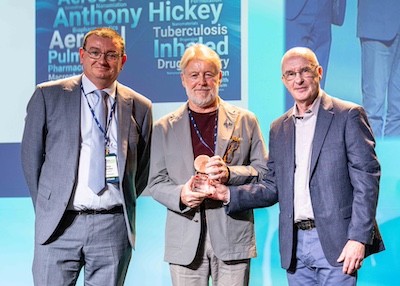
The RDD 2026 scientific program opened with the presentation of the Charles G. Thiel Award to Anthony Hickey, currently CEO of Astartein. Over the course of his lengthy career, Hickey founded OINDP-focused CDMO Cirrus Pharmaceuticals, which was acquired by Kemwell in 2013 and later by Recipharm, and generic inhaled drug developer Oriel Therapeutics, which was acquired by Sandoz in 2010.
The award was established in 2006 to mark the 50th anniversary of the invention of the metered dose inhaler by Thiel and his colleagues George Maison and Irving Porush at Riker Laboratories (later 3M Drug Delivery Systems, now Kindeva). This year’s award coincided with the 70th anniversary of the MDI and with the induction of Thiel, Maison, and Porush into the National Inventors Hall of Fame in recognition of the importance of their work. Previous winners John Pritchard (2018), Jeffry Weers (2020), and John Patton (2024) were on hand to help celebrate the occasion.
Emerging tools for drug development
Weers presented the keynote address, titled, “Implications of the iBCS on Molecule Design and Particle Engineering of Medicines for Inhalation,” in which he discussed work led by JDP Pharma Consulting’s Jayne Hastedt over the last decade to establish a biopharmaceutical classification system for inhaled drugs (iBCS) and how that system can be used in the development of those drugs.
Weers discussed some of the challenges of implementing the iBCS, including the difficulty of determining PK-PD relationships for inhaled drugs, the dose delivered to the lung, solubility, dissolution in the lungs, and pulmonary permeability. He also pointed out that targeting of inhaled medicines requires an approach that is opposite to that for oral medications; instead of optimizing for solubility, developers may want lower solubility to optimize residence time in the lungs.