

In fact, he said, “Solution-based spray drying to increase bioavailability is often the wrong approach for Class 1 iBCS APIs.” Using examples from some of the more than 300 molecules for inhalation he has worked on, Weers illustrated particle engineering methods that he suggested can be an effective approach for inhaled drug developers to achieve their goals.
During the Q&A following Weers’ talk, Jayne Hastedt addressed the audience, saying, “The iBCS is still under development and Jeff showed you how it is useful, but you have to remember that the test methods that we use for permeability and solubility, they are not really set in stone yet. And that’s where we need the help of people like all of you to figure out where those lines are because what Jeff showed you is that biopharmaceutics is still important and inhalation biopharmaceutics is even more important.”
Later that day in the “New Molecules Need New Methods” session, Dina Morais of Hovione presented a talk titled, “Translational In Vitro Screening Approach to Support the Development of Dry Powder Inhalation Products by Predicting Clinical Bioavailability” in which she described an approach starting with analysis of aerosol characteristics and deposition; followed by analysis of performance characteristics such as dissolution, permeability and macrophage clearance; and then moving into PBPK modeling.
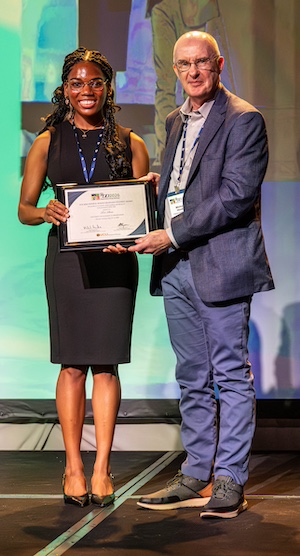
RDD 2026 presented new research devoted to tools for each stage of that approach, much of it supported by the FDA. Susan Boc of the FDA discussed “Exploring Aerosolized Powder Behavior in Dry Powder Inhalers using Advanced Imaging Techniques” in the Inspiring Dry Powder Inhalation knowledge space, and the 2026 VCU RDD Peter R. Byron Graduate Student Award went to Teri Ross from the University of Alabama at Birmingham for her poster “Particle Level Assessment of Size and Composition as a Function of Aerosol Particle Size Using Optical Photothermal Infrared Microscopy: Comparison of Fluticasone / Salmeterol / Lactose in Advair Diskus and Wixela Inhub.”
In its workshop titled, “Advancing Dissolution Testing for Inhaled Drug Products,” Copley Scientific demonstrated its new lung dissolution testing apparatus, which was launched at DDL 2025. And in the Inhalation Innovation session, the FDA’s Steven Chopski spoke about “Machine Learning (ML) and Artificial Intelligence (AI) in Generic Drug Development of Orally Inhaled Drug Products,” and his colleague Ross Walenga described “In Silico Modeling to Identify Alternatives to Charcoal Block Pharmacokinetics Bioequivalence Studies.”
New guidance on alternative approaches to BE
The Copley workshop noted that the FDA has recently been including dissolution testing among the recommendations for establishing bioequivalence in recent product specific guidances (PSGs). The FDA’s Elizabeth Bielski discussed the agency’s reasoning for new revisions to MDI PSGs during an update of her RDD 2024 presentation on alternative approaches to establishing bioequivalence.