

Inhaled oxytocin would save the lives of many women, Lambert said; however, the project is currently in need of an industrial partner and “a coalition of the willing” in order to move forward from here. Many of the earlier partnerships, he noted, were driven by a single person at an organization, and when that person left, the funding dried up. At the end of his talk, Lambert appealed to any delegates who might be able to help or who might have contacts who could help.
In the nasal delivery section of the session, Fabio Sonvico of the University of Parma began his presentation on “Nose-to-Brain Delivery – A narrow shortcut towards the CNS” by referencing the previous day’s Innovation panel and stating that “Innovation in academia is 1% inspiration, 99% frustration, and an unaccounted-for amount of persistence and fun.” Sonvico noted that there is a “big chasm between the preclinical studies and clinical development of a real nose-to-brain product” due to a lack of in vitro models of the neuroepithelium, no validated protocols for ex vivo testing, and barriers to in vivo and in silico testing.
The session also included presentations by Thara Pannadewi of Macquarie University, who described a method for in vitro permeability and transport testing in her talk on “Evaluating the transport and intracellular uptake of drugs across nasal epithelial cells and neuroblastoma cells”; Mathilde Felding of the Technical University of Denmark who discussed “Development and characterization of in situ hydrogels for nasal delivery of antibiotics using the Alberta Idealized Nasal Inlet (AINI)”; and Aviva Chow of The University of Hong Kong who presented his research on an “Inhalable Nanoagglomerate Powder of Cholecalciferol for Nose-to-Brain Delivery: A Promising First-Aid Therapy for Ischemic Stroke.”
Innovation in sustainability
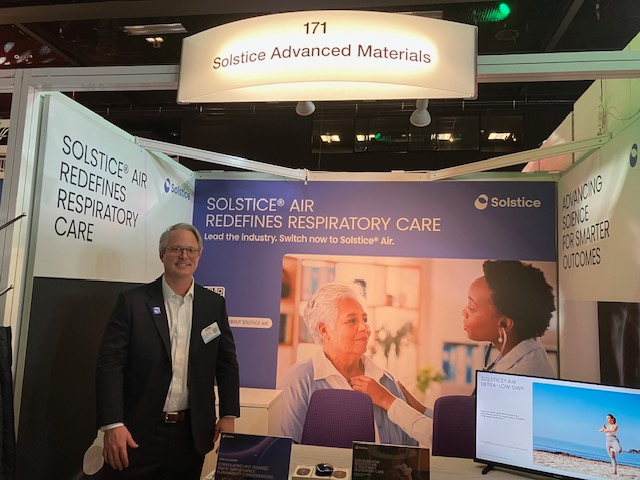
Little discussion of the LGWP propellant transition or sustainability in general occurred during the lecture program; however, plenty of companies in the exhibition were promoting their products and services related to those issues. In some cases, companies seem to have backed away from using terms like “low global warming potential,” “sustainability,” and “climate” — for example, HFO-1234ze maker Solstice promoted its propellant with the slogan, “Solstice Air redefines respiratory care” — but the majority continued to promote benefits to the environment.
HFA 152a maker Orbia teamed up with CDMO Bespak and MDI filling specialists DH Industries for a pre-conference event discussing the current progress of the transition. In a filmed interview followed by a Q&A, representatives of the companies acknowledged that while the transition is fully underway at large pharma companies, smaller companies are still waiting to commit to switching their MDIs to the new propellants. With the price of HFA 134a certain to rise in the future, they emphasized that the time to act is now.