



The innovation session began with a plenary talk by David Morton of Deakin University titled “From Ideas to Products in Aerosol Drug Delivery (ADD): Barriers to Innovation.” Morton emphasized the importance of a diverse team, especially the inclusion of early career scientists open to new ideas, and noted that scientists may need to think more about issues such as cost of materials and affordability.
Morton’s lecture was followed by presentations by and a panel discussion featuring Anna-Dorothea Gorki, Chief Scientific Officer of YGION Biomedical; Etheralis BioAI DirectorJag Shur; and Charlotta Gummeson, of Trustpoint Consulting, who moderated the panel. Most of the discussion focused on attitudes towards innovation and risk-taking, with some questions of funding addressed.
Innovation in preclinical development

Although the Innovation session omitted the issue of regulatory issues as barriers to innovation, Proveris Scientific‘s stand in the exhibition addressed that factor with its slogan, “Where Innovation Meets Regulation.” And in the Advances in Preclinical Drug Development session, chair Ben Forbes of King’s College London credited proposed regulatory changes around animal testing, along with other external pressures for reductions in the use of animals, as one of the motivations for the session. Forbes asked, “Are we doing pre-clinical development better these days, and if not, why not?”
Several of the talks in the preclinical drug development session discussed novel in vitro methods using human cells. Victoria Hutter of ImmuONE described development of a human macrophage motility assay in her talk on “Advances in in vitro endpoints for inhaled drug delivery safety assessment.” Paul Fitzpatrick of AstraZeneca talked about the use of multiple assays, including a human lung-on-chip model, and Mike Pasteur of the University of Tours reported on his work using human primary nasal cells for assessment of nasal drugs in development.
Other talks in the session focused on the use of lung tissue harvested from animals in place of testing on live animals. Sally Yunsun Kim of King’s College London described the use of mouse tissue in her talk on “Precision-cut lung slices as a platform to investigate cytotoxicity and efficacy of novel therapeutics,” and Per Gerde of Inhalation Sciences gave a talk on the “Effect on lung permeation of various formulation efforts invested in the inhaled antibiotic apramycin as measured in the ex vivo isolated, perfused, and ventilated rat lung.”
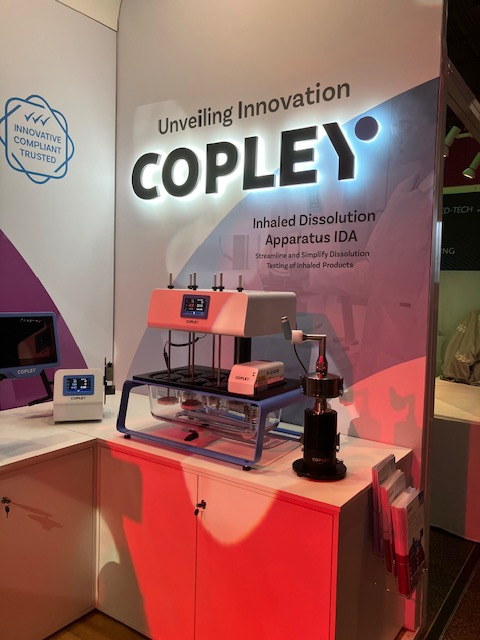
In the exhibition hall, Copley Scientific‘s display of new apparatus for assessment of lung dissolution drew a great deal of attention as developers look for a validated method of dissolution testing for inhaled drugs due to rising interest in development of poorly soluble drugs and of biologics that require high payloads. As Copley’s Clair Brooks discussed in a 2024 Q&A with OINDPnews, the FDA has been issuing product specific guidances (PSGs) with alternate methods for determining bioequivalence, and the agency has talked about study design considerations for inhaled dissolution testing, including at RDD 2024.

