

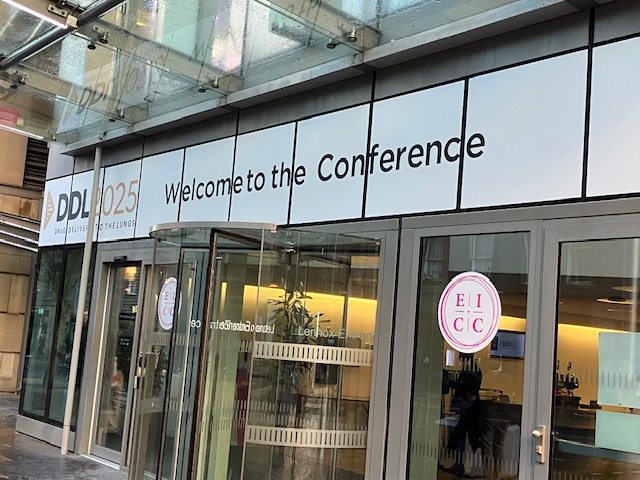
Once again, the annual Drug Delivery to the Lung (DDL) conference drew approximately 1,000 inhaled and nasal drug delivery experts to the Edinburgh International Conference Centre, with an additional 100 delegates attending online. With a program focused on innovation, DDL 2025 offered 3 days of podium presentations, an expanded poster exhibition, and more than 100 companies promoting products and services in the exhibition hall.
Awards
The DDL 2025 scientific program kicked off with the presentation of the DDL Annual Lecture by Gerhard Scheuch, who is currently CEO of GS-Bio-Inhalation, an OINDP consulting firm. Scheuch has a long history of founding organizations in the OINDP space, including Activaero, Inamed, and Ventaleon, and has published over 150 papers on aerosols and drug delivery to the lungs.
In his talk, Scheuch reviewed his 45-year career in aerosol science and drug delivery, starting in Willi Stahlhofen’s lab, particularly highlighting his work debunking false beliefs about aerosols, including the once-common idea that all particles deposited in the lungs would be cleared within 24 hours; the still-common idea that only particles smaller than 5 μm can be inhaled; and mistaken beliefs about how particles reach the deep lung.
Scheuch also described his efforts during the COVID-19 pandemic to debunk misinformation about aerosol transmission of SARS-CoV-2 from the World Health Organization. He recounted experiments he conducted on the generation of aerosols by the respiratory tract during respiration and the identification of superspreaders who exhale extremely high concentrations of particles.
On the second day of the conference, the DDL Emerging Scientist Award was presented to Cathy Fromen from the University of Delaware. At the beginning of her award lecture, Fromen stated, “As an academic, my product is really my students” and noted that all of the work she would present is really that of the students. “I just get to get out of their way and try to inspire them to solve important problems,” she said.
Fromen discussed her lab’s work on aerosol immune engineering, including questions of how immune cells interact with inhaled particles and development of a poly (ethylene glycol) diacrylate (PEGDA) platform for evaluating immune cell activities. Other projects she described included 3D hydrogel modeling for investigation of effects on cells as lung tissue stiffens due to fibrosis; and the TIDAL model airway with individual flexible lobes for prediction of deposition in diseased lungs, which she previously presented at DDL 2022.