


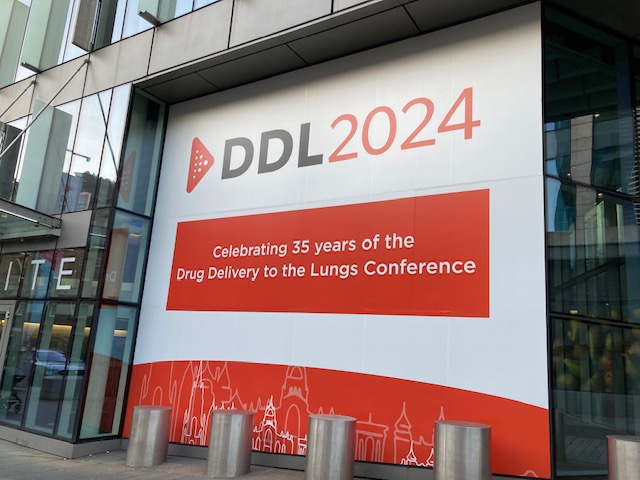
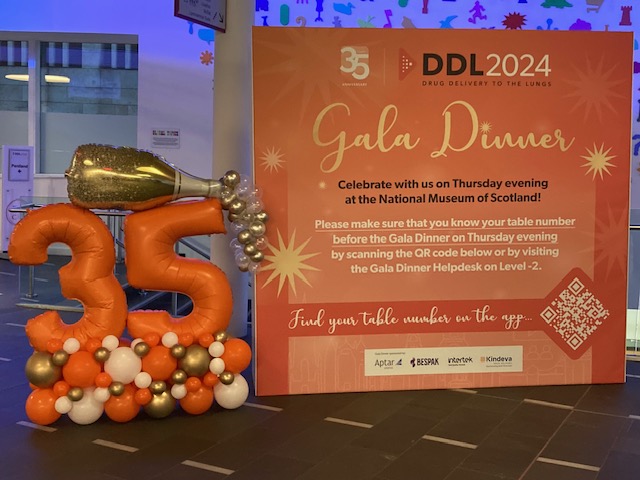
DDL 2024 drew the largest crowd ever in the 35-year history of the Drug Delivery to the Lung (DDL), with more than 100 OINDP experts attending online and approximately 1,000 attending in person at the Edinburgh International Conference Centre. DDL celebrated its anniversary with a gala dinner, timely podium and poster presentations, and a sold-out exhibition. Hot topics at this year’s meeting included the transition to LGWP propellants for MDIs, inhaled delivery of biologics, and intranasal drug development.
Awards
The 2024 DDL Annual Lecture was presented by Mike Hindle of Virginia Commonwealth University, whose talk was titled, “Delivering aerosols to premature infants, a most challenging and precious patient: Accelerating development using realistic airway models.” Hindle described his work on delivery of an inhaled dry powder synthetic lung surfactant to premature infants with respiratory distress syndrome, a challenge that requires the delivery of 30 mg of powder using only 10 ml of air at flow rates less than or equal to 3 L/min.
In his talk, Hindle reviewed the development of the SLS-EEG (synthetic lung surfactant – excipient enhanced growth) formulation and the D3 infant air jet DPI, including the role played by realistic animal and human airway models in the development process.
After being named the winner of the DDL Emerging Scientist Award, Sharon Leung of the Chinese University of Hong Kong presented her second talk of DDL 2024. Having presented a talk on the first day of the conference on “Asthma monitoring in paediatric asthmatic patients with the mannitol challenge test,” Leung focused her award talk on her work related to aerosolized phage therapy for the treatment of multidrug-resistant lung infections during her award lecture on the second day.
Leung described her methods for producing stable spray-dried phages as well as the usefulness of artificial intelligence to speed up the selection of a phage that could be useful for treating a patient’s specific infection. She also discussed the potential use of enzymes derived from phages, including research related to depolymerases; engineered endolysins for increased effectiveness against gram-negative bacteria; and combinations of phage-derived enzymes with antibiotics.