DDL meeting materialsMeeting chair Gary Pitcairn started off DDL 23 with the announcement of some attendance statistics: just under 500 attendees have registered for this year’s meeting, with 35% of them from pharma companies, 17% from academia, and 48% from “service industries.” Attendees from Europe make up 88% of the total, with 6% from North America, and another 6% from the rest of the world, including Algeria, Namibia, Saudi Arabia, India, Malaysia, Australia, and Japan.
After acknowledging the rest of the DDL committee, along with his predecessor as chair Georgina Fradley and Joy Conway, who have recently left the committee, Pitcairn also thanked Jolyon Mitchell, Darragh Murnane, Steve Newman, Steve Nichols, Jag Shur, and Regina Scherliess, who reviewed the numerous abstracts submitted this year.
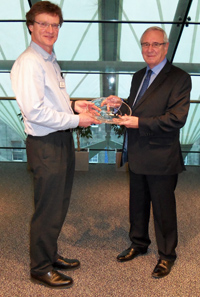
Phil Haywood presents an engraved glass plate to Malcolm Johnson after Johnson’s DDL LectureThe first talk of the day was the DDL Lecture, presented by respiratory science consultant Malcolm Johnson of GSK. The lecture, titled “Bronchodilators — the past, present and future,” traced the history of bronchodilators from the Ephedra sinica (ma huang) used for hundreds of years in Chinese herbal medicine, through the development of beta agonists and antimuscarinics, long-acting versions of those drugs, and fixed dose combination therapies. The future, Johnson suggested, would see the addition of more triple-combination therapies and possibly the development of bitter taste receptor agonists.
The remaining five presentations over the course of the day, part of a session titled “Drug Discovery and Development,” covered a range of topics with a biological focus, ranging from Ian Adcock’s talk on the role of epigenetic mechanisms in asthma and COPD to T. H. Nguyen’s discussion of the pharmacokinetics of colistin and colistin methanesulfonate delivered to the lungs of sheep.
published on
Upcoming Events Sponsored by Intertek
Want information about upcoming OINDP-related events delivered directly to your inbox? click here